

Punch, Counterpunch
Ben McCollum and his Hawkeyes get a new batch of questions from the Big Ten, and have to find answers fast.

Iowa basketball is suffering through its first two-game slump of the season, following a Sunday loss to Illinois. The Hawkeyes face Purdue tomorrow night in West Lafayette, a game which Kenpom gives them a twenty percent chance of winning. A loss there would be the third in a row, Ben McCollum’s first three-game losing streak since February 2013. It would also potentially drop Iowa to 2-4 in the Big Ten.
The Hawkeyes’ overall status remains solid. Iowa is 21st in Kenpom as of Tuesday morning, and has been in the top 25 since the win over Maryland more than a month ago. McCollum — whose hallmark has been defense, going back to his days at Northwest Missouri State — has Iowa in the national top 20 in defensive efficiency, sixth overall in defensive turnover rate and third in non-steal turnovers. Iowa has a similar statistical profile as last season’s Drake team, only turned up even higher; Drake was not nearly as effective at contesting opponent shots, even if the Bulldogs’ block rate was effectively even with Iowa’s right now.
It’s at the offensive end where Iowa has struggled in Big Ten play. Iowa is currently 12th nationally in effective field goal percentage (58.4%) and 10th nationally in two-point shooting percentage (60.9%). If those were to hold through the rest of the year, they would both be program highs for the past thirty seasons. The Hawkeyes’ current overall offensive efficiency is nearly identical to that posted by Fran McCaffery’s last five teams. While the turnover rate is considerably higher than McCaffery’s teams — that was kind of McCaffery’s thing post-Garza — it is still respectable, and significantly outweighed by Iowa’s penchant for forcing turnovers on defense. On its face, Iowa has the profile of a mid-seeded NCAA Tournament team.
But the chances of those holding through the rest of a Big Ten season don’t look great. Brian Rauf at Basket Under Review summed it up, prior to the Illinois loss:
Iowa's offensive rating, effective field goal percentage, and turnover rate all drop drastically against [opponents in the] the top two quadrants. The Hawkeyes also get to the line considerably less against that level of competition.
Some of this goes back to preseason concerns with Iowa and McCollum’s jump from Drake. This is a roster short on athleticism and individual creation. As good as Stirtz is, it’s much more difficult to rely on one player to carry everything at this level than it is at the mid-major ranks.
The margin for error is already small for Iowa because of the pace it wants to play at, and the lack of other creators makes it even smaller.
Things didn’t get better against Illinois, either. Here are Iowa’s offensive rating, effective field goal percentage, and turnover rate against the best five opponents on its schedule (Iowa State, Michigan State, Illinois, Minnesota and UCLA) versus its overall ratings:

Of course, those are good opponents! Three of them are among the 15 best teams in the country! It’s understandable that Iowa would not perform as well against the best teams on their schedule. However, it’s also become clear that the other games in the Hawkeyes’ early slate meant to bolster its position haven’t panned out. Of Iowa’s twelve wins, just one — UCLA — is against a team with even a modest chance of an at-large bid to the NCAA Tournament. Ole Miss, which was Kenpom #34 when they lost to Iowa in November, has gone 4-6 since then and dropped 36 spots in the standings. The only other Iowa opponent in the Kenpom Top 100 at the moment is Grand Canyon, currently 88th.
It’s a bit simplistic to state that Stirtz is Iowa’s only offensive weapon. Tavion Banks has been an effective scorer in the frontcourt, Cam Manyawu’s Reggie Evans game is strong — he’s 67th nationally in offensive efficiency at the moment — and Alvaro Folgueiras has been awarded additional playing time as his scoring has improved. However, with the possible exception of Banks, those players’ shots are dependent on Stritz’s ability to create. The same holds true for Cooper Koch, Tate Sage, Isaia Howard, etc. It’s an offense built around Stirtz’s unique abilities as a creator.
Coaches are starting to figure it out. Iowa State tried to combat Stirtz with the length and athleticism of Killyan Toure, and Iowa almost ball-screened their way to an upset as a result. Subsequent opponents are playing Iowa with more targeted defenses. In the second half, UCLA moved to a full-court press and switched all of the Stirtz ball screens, daring Iowa to find another ball handler to get into the frontcourt and another consistent scorer once they were there. Illinois went to what was, effectively, a Box-and-1, in order to put a defender on Stirtz at the top of the key with support against any drive though the lane. Even if opponents merely slow down Stirtz, it has a direct effect on Iowa’s success. Here’s Stirtz’s Kenpom profile this year, with his per-game offensive efficiency rating on the right. See if you can find a pattern.
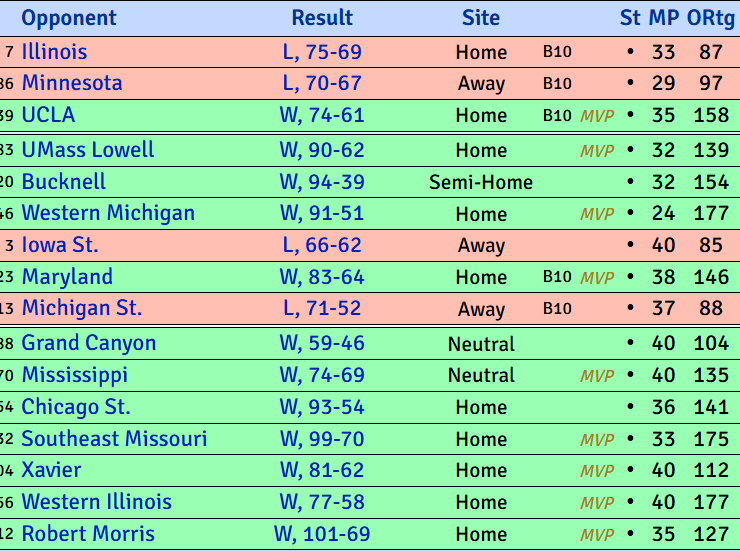
We’re seeing another anti-Stirtz tactic at the other end of the court, as well. Stirtz famously plays virtually every available minute. In 2025 for Drake, he sat for a total of 16 minutes in 33 games against Division I opponents. Stirtz picked up four fouls once, in a ten-point win at Southern Illinois, and he didn’t pick up that fourth foul until there were three minutes remaining. Watching Iowa this year, it becomes clear how McCollum shielded Stirtz from foul trouble. McCollum does not typically have his point guard defending the other team’s point, opting instead for Isaia Howard. Stirtz is generally assigned to a lower threat, frequently a corner three specialist. Not only does that tactic limit his activity at the defensive end, preserve his stamina for operating the offense, and put him in perfect position to receive an outlet pass when Iowa forces a turnover, but it also keeps him out of the line of the referee’s fire.
Opponents have clearly taken notice. Even the most modest of opposition offensive threats are now the recipients of back screens and double screens, and are finding the courage to drive to the basket on Stirtz. The result: Eleven Stirtz fouls in the last three games, and more time for Stirtz on the bench in those three games (23 minutes) than he recorded all of last season. The strategy almost backfired for Illinois, as Iowa’s offense came alive with Stirtz on the bench, but there’s no question that he’s Iowa’s most important offensive player, and that he’s being schemed out of the game since Big Ten play formally started.
I don’t think there’s any real question that McCollum is a great coach, or that Iowa is in a far better place than it was at this time last season; last year’s Hawkeyes were in the midst of their catastrophic West Coast trip at this point in 2025, and would win just five more games all season. I trust that a coach with McCollum’s track record will make the adjustments necessary to prevent this losing skid from turning into a season-ending disaster. But if anyone truly believed that McCollum could roll into the Big Ten with his Drake team, run the same system he had at Drake, and contend for a conference title has received a hard dose of reality this week. There are a new set of questions being posed by the Big Ten’s best coaches. We’ll soon see if McCollum can find the answers.
The slow starts are what have me super concerned. I love Ben as a coach, but two games in a row his team was not ready to play at tip off. Hopefully, the reported flu/illness that has been rampant on the team exacerbated that. His style is not built to continually overcome 10-15 point deficits.
This team is essentially what I expected: à solid defensive team buoyed by having a great offensive player. I don’t think they’ll be half as good next season when there isn’t an All-American offensive player on the team.
But it’s what to expect. Fran had the best player in college basketball a handful of years ago and Iowa’s highest ever draft pick thé following season followed by another 1st round pick. He had two bad recruiting cycles and with bad luck (Freeman and Koch both being out for the year is certainly that), and it showed. It was bad.
But he had his best or second-best recruiting class lined up preceded by a solid recruiting and transfer class. But, like all modern day fans, a couple bad seasons meant it was time to start something new. It is what it is.